The Weight You’re Carrying
Surface inherited stories, beliefs, formative experiences, labels, and hard-won gifts.
A guided experience for understanding what a leader carries, how identity shapes leadership, and where the next meaningful growth edge lives.
Surface inherited stories, beliefs, formative experiences, labels, and hard-won gifts.
Move from what has been carried toward the identity a leader claims and is becoming.
Connect identity with fifteen observable BRITER™ leadership competencies.
Notice conversational habits and the depth of dialogue available to the team.
Examine psychological safety, leadership commitments, and what people actually experience.
Translate insight into practice, evidence, and the BRITER™ measures that matter.
Your backpack is your identity.
Every person carries experiences, roles, relationships, values, expectations, successes, disappointments, assumptions, and stories about themselves and the world. Those things travel with us into work.
They can influence what we notice, how we interpret what happens, the meaning we make, and how we respond. Backpack Theory™ makes that invisible load visible.
It helps explain how and why what people carry into work shapes what they notice, interpret, question, connect, contribute, and experience. It organizes ideas so people can understand the relationship between identity, role expectations, burnout, and human-system interaction.
It is grounded in workplace psychology, identity, burnout, role expectations, and human-system interaction, and it is still developing as an original model shaped by leadership experience and applied practice.
You wear it into work. It carries who you are: lived experience, values, knowledge, perspective, relationships, history, and sense of self. Some heaviness may already be in the backpack before work ever touches it. Work does not create the whole backpack, but it can interact with it.
Who I am: experiences, identities, values, background, roles, and parts of self that influence how I encounter work.
What I know: expertise, lived knowledge, education, institutional knowledge, and lessons learned.
How I make sense of things: what I notice, how I interpret situations, patterns I recognize, assumptions I question, and judgment developed through experience.
How I affect the system: trust, connections, communication, reputation, energy, influence, and the way other people work differently because I am there.
The four compartments are not the backpack itself. They help sort what work adds, activates, amplifies, or borrows from the person. Some heaviness came in with the person. The leadership question is what the work, role, culture, and system do with it.
Workload, staffing gaps, unclear processes, decision bottlenecks, competing priorities, and the daily mechanics of getting work done.
Norms, unwritten rules, belonging, psychological safety, values gaps, and the way people learn what is rewarded, ignored, or risky.
Conflict, vigilance, care, disappointment, grief, frustration, and the inner cost of staying steady while carrying pressure.
Problems, responsibilities, expectations, stories, or unfinished system work a person carries because the role, team, or organization has not carried it clearly.
Which parts of what you carry are invited, named, valued, and used?
Which knowledge, identity, perspective, relationships, or judgment stay invisible?
What parts of self or experience feel unwelcome, risky, or too much for the room?
What operational, cultural, emotional, or borrowed weight have the role, culture, expectations, and relationships added, activated, or amplified?
Which responsibilities, stories, problems, or patterns have become yours to carry even when they belong to a role, process, team, or system?
What works differently because your presence, judgment, and contribution are part of this place?
Experience can become wisdom. Relationships can create connection. Values can offer direction, and the past can strengthen resilience. What we carry can also shape an interpretation before we notice it happening.
The first step is noticing what you carry and what the system does with it.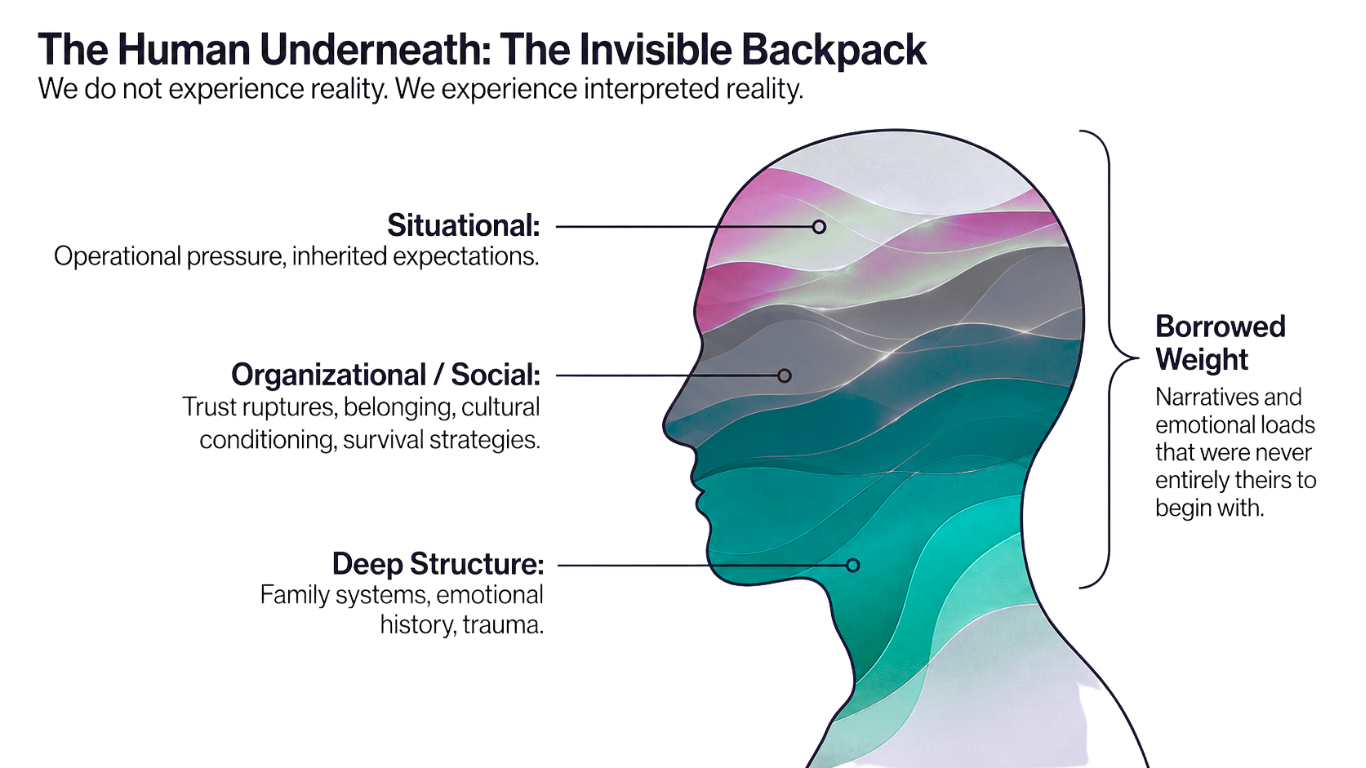
The backpack is not the whole story. People carry pressure, history, inherited expectations, and survival strategies, but they also carry identity, judgment, relationships, wisdom, and presence. This moment asks leaders to slow down enough to notice what the person has learned to carry, what the system has added, and what support would let more of the human show up.
BRITER starts here: notice the weight, then turn toward the person underneath it.Keep the parts that strengthen who you are and how you lead. They belong with you.
Look more closely at an experience, assumption, reaction, or story that may be shaping the present.
What happened may stay the same, while a different meaning can open a different possibility.
Something can be real and meaningful without leading your response in every room.
Identity matters organizationally because it affects what someone sees, knows, questions, connects, contributes, and experiences. The BRITER move is to ask what happens between the person and the system, not only what is inside the person.
This is the organizational-worth question. It is not ego. It is whether a person's knowledge, judgment, identity, perspective, relationships, presence, and contribution matter in the way the system works.
The system may recognize credentials, tenure, relationships, work ethic, specialized knowledge, or a leader's ability to steady a room.
Look for what is named, invited, trusted, and repeated.The organization may rely on someone's judgment, emotional labor, institutional memory, credibility, translation skills, or ability to connect people across roles.
Notice what the system depends on, even if it is not in the job description.A system can miss lived experience, cultural knowledge, relational influence, quiet expertise, dissent, discernment, or the effort it takes to keep work moving.
Pay attention to what matters but stays invisible.Some rooms make people tuck away grief, identity, history, caution, creativity, voice, faith, boundaries, or the parts of themselves that do not fit the dominant norm.
Name the cost of belonging to the room.The system can add confidence, purpose, mentorship, and opportunity. It can also add pressure, vigilance, confusion, misplaced responsibility, or stories a person was never meant to carry alone.
Separate growth from unnecessary weight.A person's presence can change decisions, language, trust, pace, expectations, relationships, and the questions the organization learns to ask.
This is consequence, not ego.You can’t choose what to carry forward until you can see what you carry, what the system does with it, and what your presence changes.
Take the Backpack Assessment to explore what you carry into work and leadership, and how it may shape the way you interpret what happens around you.
Unpack your backpack A reflective 30-statement experience. Your answers stay in this browser.The backpack is identity. Some weight comes in with the person, and some weight is added, activated, amplified, or borrowed by the work. The system recognizes some of what you carry, uses some of it, overlooks some of it, and changes some of it. Reflection creates room to notice and choose what happens next. Backpack Theory™ helps you see what travels with the person; BRITER™ helps you read what happens between the person and the system.
Stage Two helps a leader interpret what emerged in the backpack work and draft a leadership identity statement in their own words.
What part of your journey has most shaped who you are as a leader?
Who is the leader you are actively moving toward?
What identities shape how you see yourself and how you lead?
What does your presence feel like to the people around you?
This page gives leaders the shape of the journey. The facilitated experience helps them work through it: guided reflection, the BRITER™ petal assessment, the fifteen competencies, communication and culture practices, organizational measures, a thoughtful debrief, and a personal growth plan. The value is not simply seeing the model. It is making meaning from it and deciding what to practice next.