BRITER™ Leadership Architecture
Identity at the center. Four developmental layers radiating outward. Development moves inside-out and outside-in.
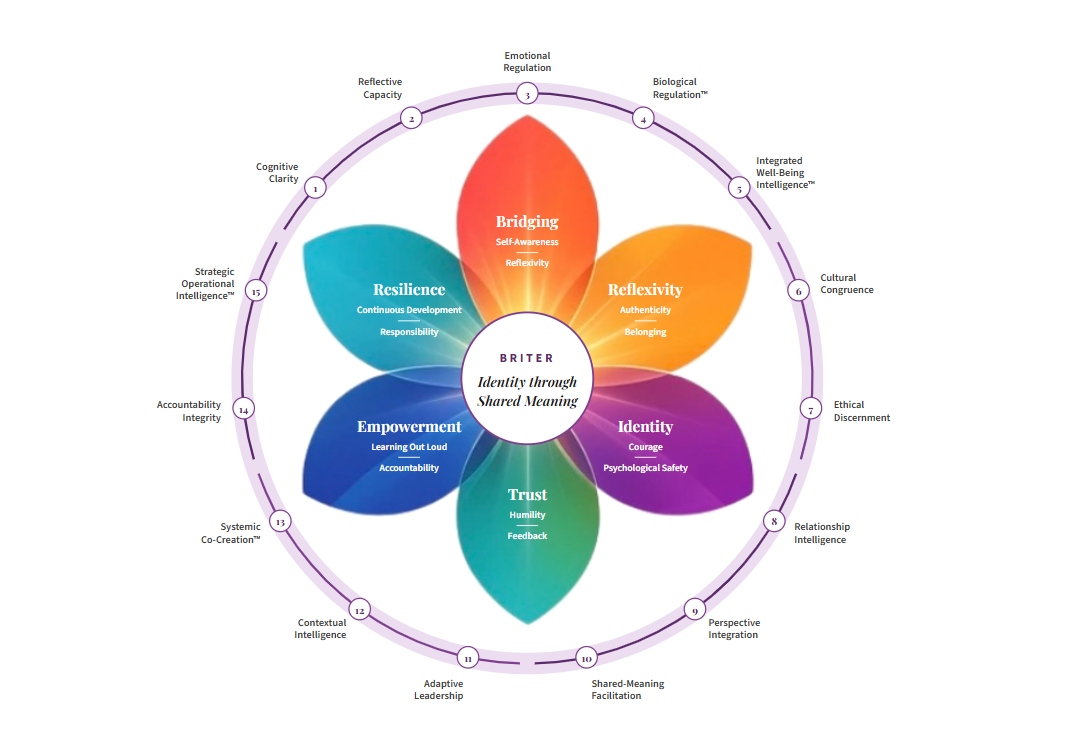
Center: Identity
Identity is the center of BRITER™, not one of the four layers. Identity has an inner and outer side, and the four developmental layers radiate outward from it.
Inner Identity — Who I understand myself to be
- Experiences and personal history
- Values and beliefs
- Strengths and needs
- Motivations
- Assumptions about leadership
- Sense of purpose
- Self-narrative
- Who I am becoming
Outer Identity — How others experience me
- Presence
- Communication
- Behavior
- Choices
- Relationships
- Use of power
- Consistency
- Leadership impact
Layer 1: Awareness & Meaning-Making
This is how leaders make sense of themselves, other people, and what is occurring around them. This must be closest to Identity because leaders cannot intentionally change what they cannot yet see.
- Self-awareness
- Awareness of others
- Assumptions and mental models
- Perception and interpretation
- Emotional awareness
- Perspective-taking
- Reflexivity
- Separating evidence from interpretation
- Recognizing patterns, triggers, and bias
- Learning and unlearning
Layer 2: Relational Practice
This is how the leader's identity and meaning-making become visible in interactions with other people. This is where Inner Identity begins becoming Outer Identity through actual relationships — not merely through the leader's intentions.
- Listening
- Dialogue
- Trust-building
- Psychological safety
- Empathy
- Feedback
- Coaching
- Conflict
- Accountability
- Belonging
- Sharing power
- Supporting agency
Layer 3: Organizational & Systems Practice
This is how leadership identity and relational patterns become embedded in the broader environment. This layer matters because leadership is not just interpersonal. A leader may have excellent conversations and still maintain systems that contradict those conversations. Culture notices the contradiction — even when the leader does not.
- Culture
- Structures
- Systems
- Policies
- Decision-making
- Strategy
- Change
- Communication patterns
- Resource allocation
- Talent systems
- Performance expectations
- Informal norms
- Organizational learning
Layer 4: The 15 BRITER™ Leadership Competencies
The competencies form the outermost layer because they are the observable, measurable expression of the entire system. They demonstrate how the leader integrates Inner and Outer Identity, awareness and meaning-making, relational leadership, organizational and systems thinking, and intentional action.
The 15 BRITER™ Leadership Competencies
Use this video as the bridge between the architecture and the observable behaviors. The competencies are not a checklist sitting outside the work. They are how the deeper BRITER layers become visible in leadership practice.
Self & Values System (7)
| Competency | Definition |
|---|---|
| Cognitive Clarity | Thinking clearly under complexity; separating signal from noise, fact from assumption. |
| Reflective Capacity | Examining experience after it happens to extract a transferable lesson. |
| Emotional Regulation | Noticing and metabolizing your own state before it drives a decision or a room. |
| Biological Regulation™ | Tending sleep, recovery, and nervous-system load so regulation is possible. |
| Integrated Well-Being Intelligence™ | Holding cognitive, emotional, and biological regulation as one system. |
| Cultural Congruence | Living the organization's stated values in behavior, not only language. |
| Ethical Discernment | Choosing well among competing legitimate goods, not just right vs. wrong. |
Relational & Organizational System (8)
| Competency | Definition |
|---|---|
| Relationship Intelligence | Reading what a relationship needs — trust, repair, boundary, candor — and supplying it. |
| Perspective Integration | Synthesizing multiple legitimate perspectives without reducing them to one. |
| Shared-Meaning Facilitation | Surfacing interpretations and building shared understanding for coordinated action. |
| Contextual Intelligence | Reading the specific conditions of a moment rather than a generic playbook. |
| Adaptive Leadership | Leading where the answer must be built, not retrieved. |
| Systemic Co-Creation™ | Redesigning systems with the people inside them, not for them. |
| Accountability Integrity | Fair, behaviorally grounded accountability — expectations, authority, evidence aligned. |
| Strategic Operational Intelligence™ | Connecting daily decisions to long-range strategic intent, both directions. |
How the Layers Connect
Each competency traces back through every layer:
| Observable Competency | Relational Foundation | Meaning-Making Foundation | Identity Foundation |
|---|---|---|---|
| Effective feedback | Trust and dialogue | Separates evidence from interpretation | Secure enough to give and receive feedback |
| Inclusive leadership | Belonging and shared agency | Recognizes assumptions and perspectives | Understands how identity influences power |
| Change leadership | Engagement and communication | Interprets patterns and competing meanings | Maintains coherence through uncertainty |
| Accountability | Clear expectations and care | Distinguishes facts, impact, and interpretation | Acts consistently with stated values |
| Strategic thinking | Collective understanding | Widens the lens and connects patterns | Understands purpose and leadership responsibility |
Inside-Out and Outside-In
Inside out: Identity shapes meaning-making, relationships, systems, and competency expression.
Outside in: Feedback about competency behavior helps leaders examine systems, relationships, assumptions, and identity.