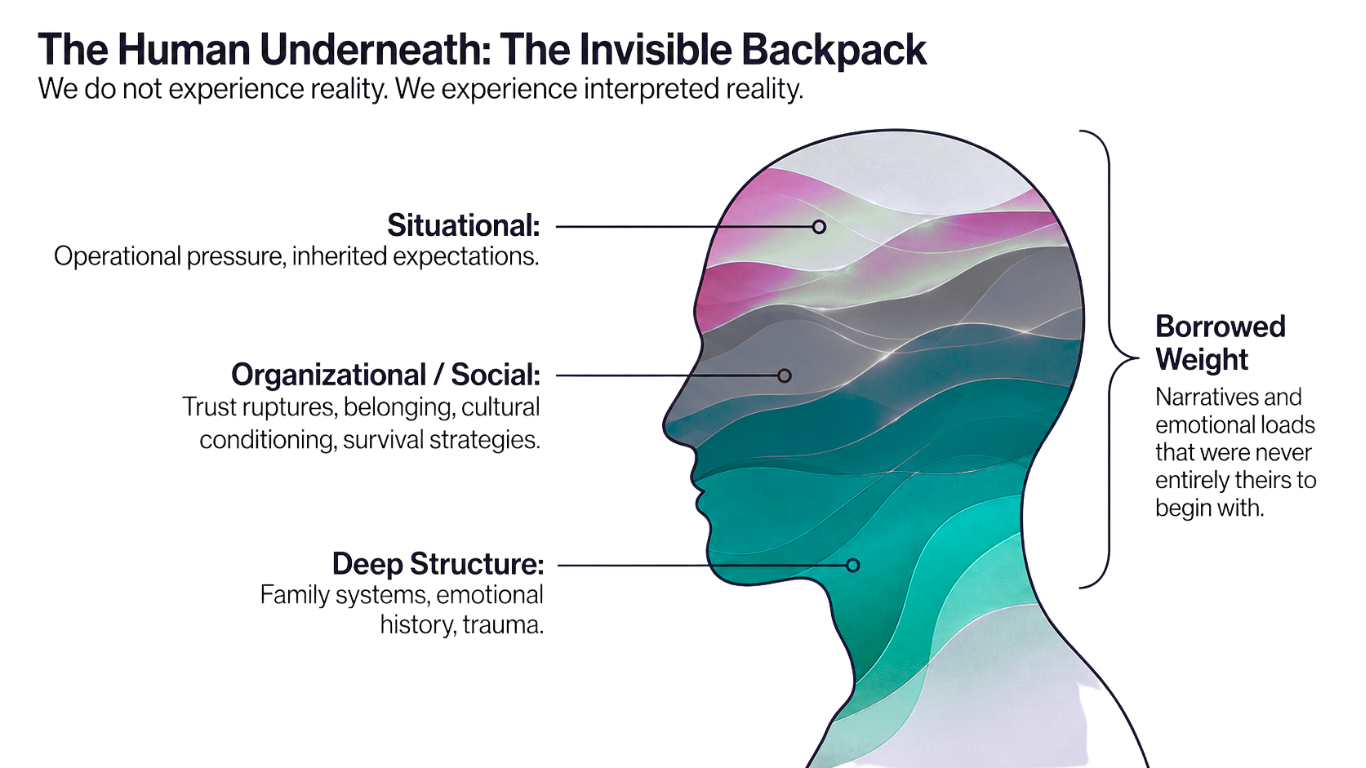
Notice what Maya carries into the room before deciding what her behavior means.
BRITER Story Series · Episode 1
The Story We Become.
A guided story about Maya, the invisible backpack, interpreted reality, and the moment a person begins to understand what the system has been asking them to carry.
A BRITER Reflection
When Power Gets Louder
People learn whether their voice is consequential through what happens after they use it.
Read the full articleThe additional story
Maya is carrying more than the room can see.
Maya's story matters because the visible moment is never the whole moment. A meeting, a comment, a missed invitation, or a shift in tone can land on top of years of learning what is safe, what is rewarded, and what gets dismissed.
The video can introduce the idea. The fuller story asks us to slow down and notice the human interpretation underneath it: What did Maya believe the room was saying about her competence, value, voice, and belonging?
BRITER lens: People do not respond only to what happened. They respond to the meaning they make from what happened, especially when old weight and current system signals collide.
How to use the series
Watch for the story under the story.
Separate the event from the interpretation, then ask what the system may be teaching her to expect.
Name the next wise move for the person, the leader, and the conditions around the work.
Video 1 · The human under the role
Start with Maya, not the moment.
Before feedback, performance, or presence are evaluated, Maya is already carrying identity, history, knowledge, judgment, relationships, and presence into the system.
What the video names
The person walks into work with an invisible backpack. What they carry shapes what they notice and how they respond.
What the story adds
Maya may look quiet, hesitant, guarded, or intense. BRITER asks what the behavior is protecting, expressing, or trying to make sense of.
Pause and ask
- What part of Maya is visible to others?
- What part of Maya might be working hard underneath the surface?
- Where might a leader confuse protection with resistance?
Video 2 · Interpreted reality
The room writes back.
Maya is not only bringing a story into work. The system is also sending signals back through expectations, tone, silence, access, trust, pressure, and recognition.
What the video names
People experience interpreted reality. The same event can mean very different things depending on what someone has learned to expect.
What the story adds
If Maya reads a moment as dismissal, danger, or proof that she does not matter, the leadership question becomes: What signal did the system send?
Pause and ask
- What did Maya see or hear?
- What meaning might she have made from it?
- What signal could a leader send next to create clarity without minimizing her experience?
Video 3 · Naming the pattern
The story becomes a choice.
Once Maya can name the story she has been living inside, reflection becomes movement. She can decide what to carry forward, what to unpack, and what needs a new response.
What the video names
Insight is useful only when it changes what a person can see, say, choose, or practice next.
What the story adds
Maya's shift is not about blaming herself or blaming the system. It is about naming the interaction between the two.
Pause and ask
- What story has Maya been using to make sense of work?
- What evidence supports it, and what evidence complicates it?
- What becomes possible when the pattern has language?
Video 4 · The Messy Middle
When the old story no longer fits.
The Messy Middle is the space between what Maya used to believe, what the system is revealing, and what she has not yet learned how to practice with confidence.
What the video names
Change often feels unclear before it feels empowering. People may be learning while still carrying the weight of the old pattern.
What the story adds
Maya does not need a forced happy ending. She needs language, steadiness, and conditions that let a new story become believable.
Pause and ask
- What is Maya between right now?
- What old signal is still loud?
- What support would help the new story become real in practice?
Video 5 · The Messy Scribble
When change does not feel clear yet.
The Messy Scribble gives the middle of change a picture: assumptions, emotions, uncertainty, mixed messages, and old experiences crowding together before growth becomes visible.
What the video names
The middle often looks like a mess before it looks like meaning. Growth happens through the scribble, not by pretending it is not there.
What the story adds
Maya may not need a perfect answer yet. She may need help naming what is known, unknown, assumed, and felt.
Pause and ask
Read the full Messy Scribble article →
- What is crowding the scribble right now?
- What is the person trying to make sense of?
- What would create clarity, steadiness, or support?
The story is the doorway.
Once Maya's story is visible, the next BRITER move is to decide what needs reflection, what needs language, and what needs to change in the system around the person.
Use one video at a time. Let the story breathe. The insight usually arrives in the pause after the video, not during the explanation.
01Set the story
02Play the video
03Ask the questions
04Name one next move
Jobe · Chapter 1
Sorting what is mine from what is not mine.
Jobe's story follows a different kind of Messy Middle: the space between accountability and self-trust, where a person has to examine evidence without accepting every label placed inside the backpack.
What the video names
Reflection, scapegoating, and gaslighting can become tangled when feedback is vague, standards shift, and perception is treated as fact.
What the story adds
Jobe does not need villains. He needs clarity. He needs to know what belongs to him, what belongs to the system, and what has been placed in his backpack.
Pause and ask
Read Jobe's full story →
- What feedback is specific enough to learn from?
- What labels are being treated as evidence?
- What belongs in Jobe's backpack, and what needs to be returned to the system?