
Bridging
Can meaning travel across the system?
Follow the pathway that fits your question, your team, or the system you are trying to understand.
This page keeps the full set of tools and interactive models previously on the home page. Start with the pathway, the applied tools, or the research behind the work.
Start with the work in front of you. Each pathway brings the relevant BRITER methods, tools, and learning together without asking you to decode the entire body of work first.
What are you trying to understand, develop, or change? Choose the question closest to the one you are carrying.
CAREER & LEADERSHIP GROWTHCareer CraftingExplore career seasons, competencies, and the conditions that fit your life and leadership.Open the interactive workspace →“Performance isn’t where it needs to be.”
Performance conversations, one-on-ones, accountability, feedback, goals, Intentional Growth Plans, and performance alignment.
Pathway 02“How do we develop people?”
15 competencies, self-assessment, Competency Companion, Scope Canvas, 40·30·20·10, leadership pathways, and development planning.
Pathway 03“Our leaders need to have better conversations.”
CEO QuickCoach™, Leadership Conversation Standard, Reflective Coaching, feedback vs. coaching, mentoring, and the Dialogue Continuum.
Pathway 04“Who is ready—and how do we build the bench?”
Succession planning, Contribution × Readiness Nine-Box, Dynamic Succession Intelligence, aspiration, opportunity, readiness, and talent development.
Pathway 05“People are carrying something through change.”
Backpack, Messy Middle, onboarding, identity transition, Making Sense of Transitions, and the Leadership Wheel/Widening Lens.
Pathway 06“Something in the organization isn’t working.”
BRITER™, Culture Iceberg, Mission & Metrics, Nine Key Indicators, organizational diagnosis, organizational conditions, and Organizational Intelligence.
Traditional measures tell leaders what happened. The BRITER forces help them see the organizational conditions forming before the numbers move. Select a force to see what it reveals.
Can meaning travel across the system?
Does experience change what we do?
Do people know who we are here?
Can the truth travel safely?
Does authority sit near the work?
Can people sustain and recover?
Organizations mature through recognizable stages of intelligence. The goal is not to claim Level 5 everywhere. It is to locate the organization honestly and strengthen what matters most right now.
The model asks: What does the organization actually do, not what does it say it does?
Culture is not the poster on the wall. It is the pattern of behavior the organization rewards, tolerates, and repeats. Leaders shape it through six visible choices.
The behavior at the top becomes the ceiling for everyone below.
Recognition and promotion reveal the organization’s real values.
The worst behavior permitted becomes the actual standard.
Attention follows measurement, and the metric shapes behavior.
Budgets and calendars reveal priorities more loudly than a strategy plan.
Whose voice enters a decision can build or erode trust and empowerment.
The highest-leverage executive act is building leaders who build leaders. BRITER separates leadership training from leadership development: 40% real experience, 30% making sense, 20% coaching, and 10% formal learning.
Know who is ready now, ready with development, and emerging.
Give every key role a named successor and an active development path.
Scale one philosophy and language to the needs of each leadership level.
Build reflection and ownership into everyday leadership conversations.
Real assignments, real backing, and real work develop capability.
Create a shared standard for what good leadership looks like here.
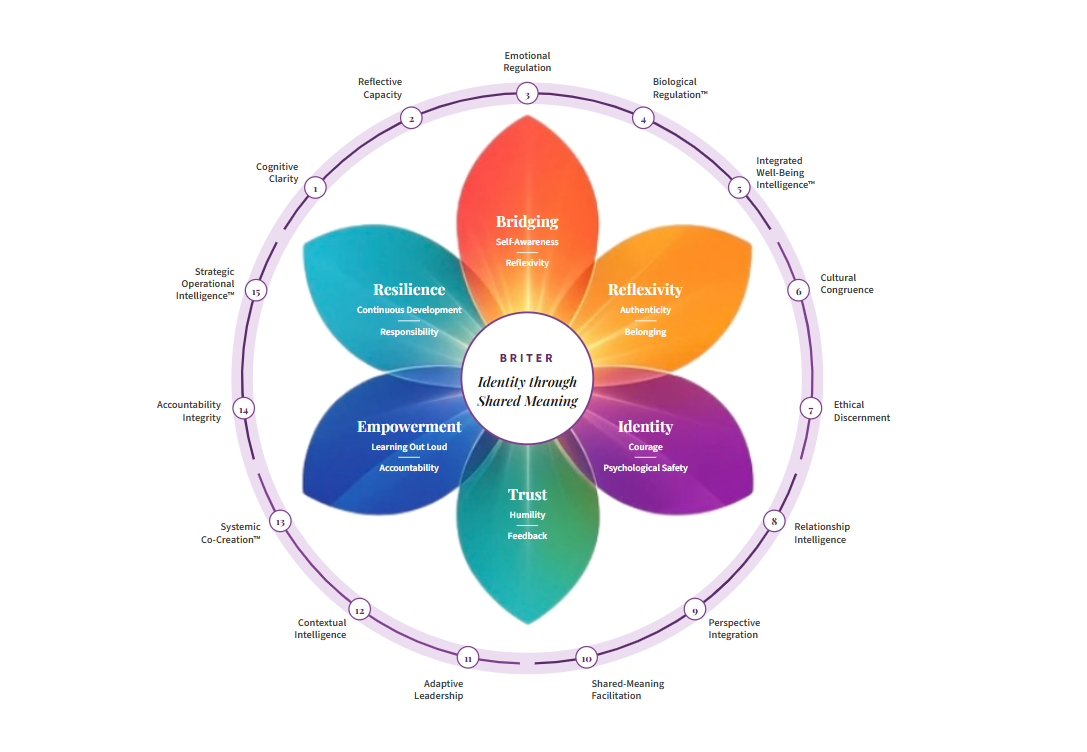
The wheel connects who the leader is, how leadership is expressed, the conditions people experience, and the competencies that make development observable.
Bridging begins with noticing how your own experience and assumptions shape the connections you build.
The staircase shows the whole model. Choose an area below to explore its competencies.
Stabilizes the leader’s inner system. Select a competency to explore it.
Aligns identity, ethics, choices, and conduct. Select a competency to explore it.
Shapes how the leader is experienced by others. Select a competency to explore it.
Expands identity into context, adaptation, and co-creation. Select a competency to explore it.
Turns identity and purpose into sustained action. Select a competency to explore it.
Use the staircase for the full overview, then select an area or competency here for more detail.
The ability to separate signal from noise, examine assumptions, and think clearly before choosing a response.
Choose giving or receiving, work through six guided steps, then save or print your preparation summary.
→An interactive dashboard for exploring the six petals, four conversation practices, and nine BRITER™ measures.
→A fillable meeting guide you can save or print, built around human entry, strategic reflection, and accountable follow-through.
→One idea. One moment. One thing to try next. The eight-slide microtraining plays here. Use the controls to pause or move between slides.
The Feedback Loop helps a leader respond to what is happening without treating the first reaction as the whole story. Follow one moment through six steps. After acting, notice what changed and return to Pause with new information.
A team member says, “We keep raising this concern, but nothing changes.”
Notice the urge to explain or defend. Take a breath so the concern can be heard.
“Thank you for saying that. I want to understand what has been happening.”
These are not decorative values. Select any commitment to see what it means, what it looks like in practice, and the BRITER force it activates.
A repeatable opening, middle, and closing rhythm makes reflection, psychological safety, and accountability visible every time people gather. Open each phase for prompts.
Regulate the emotional tone before operational pressure begins.
See progress, patterns, and system friction, not only problems and fires.
Create clarity about what matters and what moves forward next.
The Conversational Continuum tracks what happens in one conversation under tension. The Dialogue Continuum tracks the deeper relational culture a team creates over time. Select a stage to explore it.
What is not being said?
Concerns remain unspoken because speaking may feel unsafe, pointless, or costly.
Explore this stage →Is agreement real?
People say yes publicly but may not have a voice in the decision or ownership of it.
Explore this stage →Are we only trading updates?
Information moves, but people do not yet examine its meaning or implications together.
Explore this stage →Are we making meaning?
People begin to examine assumptions, impact, and recurring patterns together.
Explore this stage →Do we understand the direction together?
People have a shared reading of the situation and can name priorities, roles, and next steps.
Explore this stage →Are we building it together?
People shape the response together, influence one another, and adapt as they learn.
Explore this stage →A feeling can be a signal, but it is not the measure by itself. BRITER makes human experience measurable by defining what to look for, gathering evidence repeatedly, and comparing patterns across observable behavior, results, pulse responses, and documented follow-through.
Where are we going?
How are we progressing?
Are the work, role, and capability aligned?
Why are we driving?
What is the environment creating?
What are people actually doing?
What must be true?
What keeps the work moving?
Can people trust what happens here?
Explore the full BRITER methods, applications, and working studios that turn leadership insight into practical action.
Move from leader identity through systems, decisions, results, and learning.
Six stepsName the transition, diagnose the system, design the architecture, and move deliberately.
CoachingPrepare before, make meaning during, and create new evidence after the conversation.
FacilitationResources for listening, change, dialogue, and working with a group in the messy middle.
Complete collectionCompetencies, feedback, discernment, coaching, succession, meetings, metrics, and leadership development.
Applied diagnosisExamine a result without reducing a whole organizational system to one number.
Applied studioRead the evidence, challenge the story, and make a development move.
Interactive reflectionReflect across all six BRITER dimensions and the four kinds of weight leaders carry.
Interactive culture lensExplore the visible signals and the conditions beneath them, then read the article.
Working laboratoryExplore evidence, test an assumption, and choose a development move.
A preview of the small, repeated practices that make communication, ownership, and accountability real.
Preview the article in Articles & Insights →“Leadership is measured by what people experience.”
BRITER · Human-Centered Leadership